01
What a Yacht Charter in the Maldives Actually Is
At its simplest, a Maldives yacht charter means booking a crewed, privately operated vessel for a set number of days, then moving between atolls, reefs, sandbanks and anchorages rather than staying fixed on one island for the whole trip. The size of the vessel varies enormously across the industry, anything from a modest sailing catamaran to a full superyacht running to forty metres or more, and the experience varies just as much with it. What stays constant is the core idea. The base moves. The comfort doesn't have to.
02
The Atolls Worth Knowing Before You Book
Not every atoll offers the same version of the Maldives, and a well-planned charter route usually reflects that rather than picking anchorages at random. North and South Male Atoll sit closest to the airport and offer some of the most accessible reef diving in the country, a strong choice for shorter charters or itineraries that need to start and end near Male without burning a day on transit. Baa Atoll, a UNESCO Biosphere Reserve, is where the plankton blooms draw manta rays and whale sharks into Hanifaru Bay during peak season, arguably the single best reason to build a charter route around a specific month. Ari Atoll runs long and offers some of the most reliable whale shark sightings in the Maldives year-round, alongside a mix of channel dives and calmer lagoons. Further south and further from the standard tourist track, atolls like Laamu and Gaafu Alifu see a fraction of the traffic, rewarding longer charters with quieter reefs and villages that rarely see a visiting yacht at all. A private charter isn't locked into any single atoll. The route can move through two or three over the course of a week, chasing whatever the group wants most from each stretch of water.
03
When to Charter
Timing shapes a Maldives yacht charter more than almost any other decision. The northeast monsoon, running roughly December through April, brings the calmest seas, the clearest visibility and the most predictable weather, which is also why it's the busiest and most expensive stretch of the year to book. The southwest monsoon, from May through November, brings shorter afternoon showers and occasionally choppier water, alongside noticeably better value and quieter anchorages. Within that broader pattern, specific months matter for specific goals. Manta and whale shark season around Baa and Ari Atoll typically peaks between May and November, meaning the "wrong" season for calm seas can be exactly the right season for marine life. There's no universally correct month, only the right month for what a particular group wants most from the week.
04
Marine Life and Diving
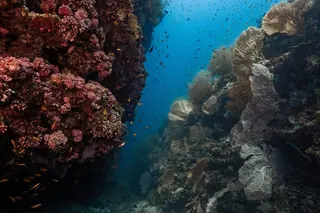
The reefs beneath a Maldives charter are, for a lot of guests, the actual point of the trip. Manta rays and whale sharks draw the most attention, concentrated seasonally around Baa and Ari Atoll, but the broader picture is just as compelling, reef sharks, turtles, and some of the healthiest coral cover left in the Indian Ocean, spread across channels and drop-offs that a single stretch of reef could never fully show on its own. A private charter with proper dive support, a dedicated dive tender, serviced gear, nitrox on request, turns diving into something the itinerary can build itself around, chasing conditions and sightings rather than a fixed daily slot. Snorkelling covers much of the same ground for guests who'd rather stay near the surface, and a moving base means a different reef most days rather than the same 200 metres of coral for the whole trip.
05
What It Actually Costs
Search for a number and the range among Maldives-based charters is wide on its own. Crewed catamarans and smaller motor yachts can start anywhere from around $15,000 to $60,000 a week depending on the operator and season, while larger luxury motor yachts typically run from around $70,000 to $120,000. Length, cabin count, crew size, season and route all move the price, along with whether the quote is genuinely all-inclusive or a base rate with fuel, diving and provisioning added separately. The only reliable way to get an accurate number is a private proposal built around specific dates, guest count and priorities, rather than a single headline figure lifted from a search result.
06
What a Week Actually Looks Like
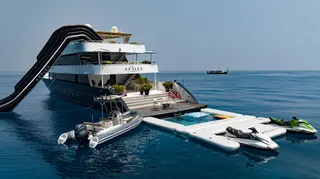
Mornings tend to open somewhere quiet, coffee on deck, a swim before breakfast, the previous night's anchorage already a little different from what guests woke up to the day before. Days build around whatever the group wants most, a dive briefing and a morning spent below the surface, jet skis and water toys out for an hour after lunch, a reef for the snorkellers, a sandbank stop, or open water and nothing else for an afternoon that doesn't need a plan at all. Evenings shift the same way, dinner on deck one night, a private setup on a sandbank the next, sunset never quite the same twice because the yacht rarely is either. None of it runs on a fixed schedule set months in advance. The itinerary bends around the guests aboard, whether that means a full day of diving and water sports or one that barely leaves the sun loungers, adjustable day to day if the mood, the weather or a manta sighting changes the plan.
07
Private Charter Versus a Cabin Booking
Not every Maldives yacht trip is a private charter. Some vessels sell individual cabins on a shared, fixed-route itinerary, more liveaboard than private yacht. The difference matters more than it might first appear. A private charter means the entire vessel, every cabin, every deck, the full crew, belongs to one group for the length of the trip, with a route built specifically around that group's interests rather than a schedule shared with strangers who booked separately. For families, celebrations, or anyone who values privacy as much as the destination itself, that distinction tends to be the deciding factor.

-480.webp)