01
One Island Is a Postcard. The Maldives Is a Country.
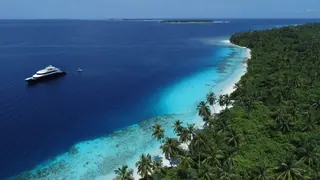
Ask someone who has been to the Maldives once what it's like, and they'll usually describe their resort. The overwater villa, the house reef, the sunset spot by the bar. All true. None of it the whole story. The Maldives isn't one island wearing different resort logos. It's a nation built from atolls that behave completely differently from each other. Some are ringed by reef so shallow you can wade out and watch fish from your knees. Others drop into channels deep enough for mantas and whale sharks to pass through on their own schedule. Sandbanks appear at low tide and vanish by evening. Lagoons shift colour depending on the cloud cover, the depth, the hour. A resort can only show a guest the version of the Maldives that exists within swimming distance of its own jetty. Everything past that horizon stays a rumour.
02
Why One Island Was Ever Enough
There's a simple reason most people only see one island. Leaving used to be complicated. Getting from one resort to another meant seaplanes, speedboats, transfer schedules and, often, an entirely separate booking. For a lot of travellers, it was easier to pick one beautiful island and stay put. The Maldives got a reputation as a place you visit rather than a place you explore, and for a long time that reputation was fair. It just isn't true anymore.
03
What Changes When the Island Isn't Fixed
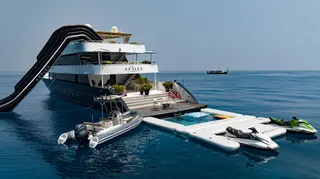
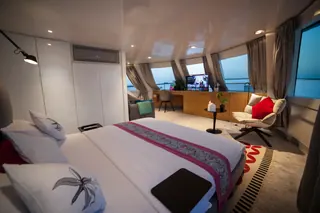
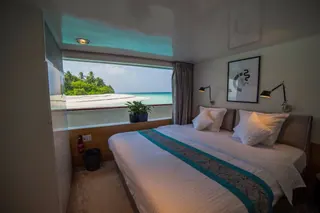
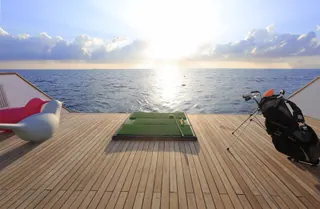
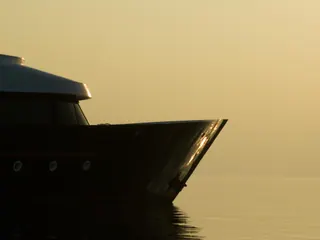
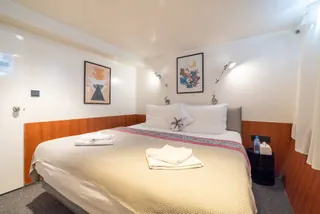
A private yacht removes the one constraint that used to define a Maldives holiday. The idea that the view has to stay the same for the entire trip. Aboard Azalea, a morning might begin near a reef busy with reef sharks and turtles. By afternoon, the anchor drops beside a sandbank that won't exist again in quite the same shape tomorrow. Dinner might happen somewhere else again, a quiet lagoon with nothing around it but water and sky. The suite doesn't change. The chef doesn't change. The crew, led by a Maldivian captain who has spent years reading these waters, stays the same throughout. What moves is everything outside the window, which turns out to be most of what people actually remember from a trip like this.
04
More Than Scenery
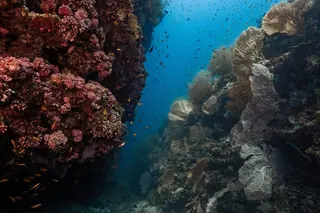
Seeing more of the Maldives isn't only about better photographs, though there's plenty of that too. Different atolls have different underwater worlds. A channel known for manta rays in one season is nothing like a shallow lagoon known for turtles in another. Snorkelling near an uninhabited sandbank feels nothing like snorkelling off a resort's house reef, if only because there's no one else in the water. Local fishing villages, when a guest wants to visit one, offer a glimpse of Maldivian life that no resort brochure quite captures. None of that is available from a single fixed point on the map. It only shows up once the itinerary is allowed to move.
05
Isn't That a Lot to Organise?
It sounds like it should be. In practice, it isn't the guest's problem to solve. A private charter comes with a crew whose job is knowing where to go and when, which reef is calm this week, which sandbank is worth the detour, which anchorage will be quiet at sunset. Guests aren't handed a map and a decision to make every morning. They're handed a plan shaped around what they actually want, adjusted daily if the mood changes. The complexity that used to keep people anchored to one island has, essentially, been handed off to someone else.
06
So, Is One Island Enough?
For some travellers, honestly, yes. A single beautiful resort, one house reef, one sunset view night after night, that's exactly the holiday some people are after, and there's nothing wrong with wanting it. But for anyone who's ever stood on a jetty looking at the horizon and wondering what's out there past the reef, the answer tends to be no. One island is a wonderful place to start a Maldives holiday. It was never meant to be the whole of it.

-480.webp)