01
Service That Isn't Scripted
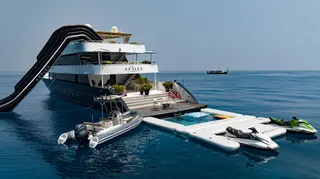
There's a particular kind of hospitality that announces itself, crew hovering a little too visibly, questions asked a little too often, a sense that good service is something being performed rather than simply happening around you. Azalea runs on the opposite instinct. A ten-person crew, captain, chef, deckhands and housekeeping among them, runs the whole yacht, which means a guest is rarely waiting on anything, not the tender, not a second coffee, not an answer to a question that hasn't been asked yet, because the person likely to have that question has usually already been thought of. It isn't the result of a script memorised the week before charter season starts. It's preparation, built from a few pre-charter questions answered before arrival, years of past charters that shape how the crew reads a group, and refinements made day by day once the crew has actually met the people they're looking after.
02
The Small Facts a Crew Actually Uses
That short list of pre-charter questions covers more ground than a standard booking form usually bothers with. How guests take their coffee. What's actually being celebrated, if anything, and how loudly or quietly that should be marked. How much space a group wants between activities, whether the ideal day is stacked with diving and water sports or built almost entirely around doing nothing at all. None of it is collected out of curiosity. It's collected because a crew that knows these things in advance can spend the actual charter executing rather than asking, which turns out to be most of what separates attentive service from something closer to genuine hospitality.
03
A Captain Who Knows the Water, Not Just the Route
Azalea's captain has spent years navigating these atolls, and it shows in ways that rarely get mentioned in a brochure. Knowing a route is one skill. Knowing which channel the mantas are favouring this particular season, or where a sandbank will actually be usable given the tide that afternoon, is a different one entirely, built from years rather than a chart. That local knowledge is what turns a planned itinerary into one that can adapt without losing momentum, chasing a sighting or a better anchorage the moment conditions suggest it's worth the detour.
04
A Chef Already at Work Before Anyone's Awake
Ask most guests what they remember about a week at sea, and food comes up faster than almost anything else. Aboard Azalea, the chef is already in the kitchen before guests are awake, working from preferences gathered before the trip even began rather than a fixed menu handed to every charter regardless of who's aboard. Breakfast can move to a deserted sandbank, laid out by the crew before guests arrive so the only footprints in the sand belong to the people about to eat there. A fishing session with the captain at sunrise or sunset can end with the same catch reappearing at dinner, prepared exactly the way that particular catch deserves. It's the kind of detail that only exists because someone thought about it well before the moment it mattered.
05
No Request Too Small, and None Too Large
Ask a crew like this for something unusual and the answer is almost never a polite explanation of why it can't be done. That's the part guests tend to find hardest to believe until they've tested it. A dish that isn't on any menu. A specialist brought aboard for the week because one guest would rather have them there. A celebration assembled on a sandbank at short notice. An entire day rearranged because the mood aboard changed overnight. Azalea is built to accommodate what guests actually want, arranged ahead of time where it needs to be, and handled quietly in the moment where it doesn't. Some of it requires planning, and anything that means bringing additional people or arrangements aboard is naturally reflected in the charter cost. But the underlying answer rarely changes. If a guest wants it, the starting position is how to make it happen, not whether to. That willingness, more than any single feature aboard, is what actually earns the phrase ultra luxury.
06
Discretion as a Habit, Not a Rule
Genuinely high-end service has a strange quality to it. The better it is, the less of it a guest actually notices. That's mostly by design. A crew handling everything, meals, anchorages, transfers, safety, the small daily logistics that would otherwise become a guest's problem, frees the people aboard to actually stop managing their own holiday. Whether that means quiet, unremarked-upon service for a family that simply wants to relax, or a more careful kind of discretion for guests who value privacy above almost everything else, the standard doesn't shift. It's simply applied differently depending on who's aboard.
07
What Ultra Luxury Actually Comes Down To
Strip away the phrase and what's left is fairly specific. A crew ratio generous enough that nobody waits. A captain whose knowledge of the water goes well beyond the chart. A chef building meals around the people eating them rather than a fixed list. A willingness to treat almost any request as workable rather than inconvenient. A level of discretion applied consistently, whoever happens to be aboard. None of that is particularly complicated to describe. It's simply difficult to deliver consistently, which is exactly why it's rare enough to be worth calling ultra luxury in the first place.

-480.webp)