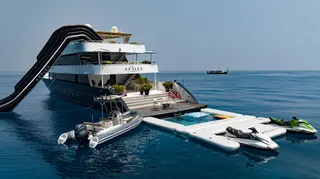
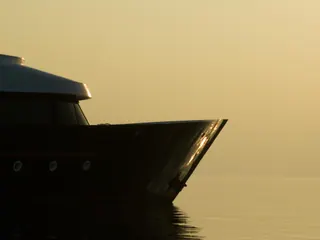
Azalea Cruise yacht anchored in turquoise water in the Maldives
Azalea JournalRead 16 min readUpdated 4 August 2026

Maldives Yacht Rental: Prices, Boat Types & Booking Tips

Learn which Maldives yacht rental fits your group, what 2026 charter prices really include, and what to check before signing a contract.

Start reading
Back to Journal
Book Your Voyage

The answer

Maldives Yacht Rental: Prices, Boat Types & Booking Tips

Read
16 min read
Updated
4 August 2026
Request proposal

Most people searching for a Maldives yacht rental picture something simple: a boat, some turquoise water, a week of paradise. What they find is a confusing mix of options: bareboat charters, crewed motor yachts, shared liveaboards, private catamarans, and superyachts that cost more per week than most people spend on a car. It is not obvious which category you actually want, let alone which one you can afford. The Maldives charter market works differently from the Caribbean or Mediterranean. Local navigation regulations, permit requirements, and the sheer geography of 26 spread-out atolls mean that what looks like a simple Maldives boat rental is actually a layered decision with real financial consequences if you get it wrong. The gap between a budget shared liveaboard and a fully private crewed yacht is not just a price gap. It is a completely different experience. By the end of this guide, you will know which vessel type fits your group, what 2026 prices actually look like, including the extras most quotes hide, and exactly what to check before signing a charter contract. To illustrate the high end of what is possible, we will reference Azalea Cruise, a fully private motor yacht operating exclusively in the Maldives for one group at a time, as a benchmark for the premium end of the market. Everything else can be measured against that standard.

The finest journeys begin long before the anchor is raised.

Azalea Journal

Why Azalea

Built for private Maldives charters

Complete Privacy

Your yacht is your private sanctuary, with space to relax and reconnect away from resort schedules.

Unrivalled Access

Reach remote islands, hidden lagoons and marine-rich atolls that resort-based travel simply can't.

Bespoke Experiences

Tailored itineraries, personal service and unforgettable moments built around your group.

Luxury Redefined

Five-star comfort, exquisite cuisine and an exceptional crew, at sea.

01

The four vessel types and who they suit

The Maldives charter fleet breaks into four practical categories. Catamarans typically run 45 to 70 feet and carry 6 to 12 guests; their shallow draft makes them exceptionally well-suited to lagoon anchoring and sandbank access, which is why they dominate the mid-range charter market here. Sailing yachts offer similar capacity in a different sailing experience, generally 6 to 12 guests, though they are less common in Maldivian fleets than elsewhere. Motor yachts cover a wide range, 50 to 100+ feet, 8 to 20 guests, with faster inter-atoll passage times that matter on a 7-day itinerary. Superyachts sit above 100 feet and typically accommodate 12 or more guests in serious luxury. The practical rule is straightforward. A group under six fits well on a catamaran or mid-size motor yacht. A large family, friend group, or expedition party of 10 to 18 should be looking at 40-meter-plus motor yachts, which offer the cabin count, deck space, and onboard amenities to keep everyone comfortable without feeling crowded. Do not undersize the vessel for a week-long trip; you will feel it by day three.

02

Crew-to-guest ratios and what they tell you about service quality

The crew-to-guest ratio is one of the most overlooked numbers in any charter comparison, and it tells you more about the experience than almost anything else. Shared liveaboards typically run at 0.5 to 0.8 crew per guest. Many luxury private yachts aim for close to 1:1, though larger private vessels often operate at slightly lower ratios while still delivering high-touch service. On paper that looks like a small difference. In practice, it is the difference between a charter that runs on a fixed schedule versus one that operates entirely on your timeline. With a thin crew, meal times are fixed, dive briefings are group affairs, and flexibility is limited. With a dedicated crew, the boat moves when you want, meals are served when you are ready, and the itinerary bends around your preferences rather than the other way around. Azalea Cruise carries 10 crew for up to 18 guests, roughly a 1:1.8 ratio that, according to the operator, defines attentive service on a vessel of that size. When you are comparing quotes, ask for this number explicitly.

03

The bareboat question (and why it barely exists here)

True bareboat, self-skippered charters are largely unavailable in the Maldives. Foreign vessels require a cruising permit from the Ministry of Tourism, and if tourists are onboard, a separate charter licence is required. The regulatory framework does not support the casual “rent a yacht, sail it yourself” model common in the Mediterranean. Even arrangements marketed as bareboat-adjacent will almost always include a licensed skipper at minimum. This matters for budget planning. Whether the listing calls it a bareboat charter Maldives-style or something else, you are paying for crew. Factor that in from the start rather than discovering it in the contract fine print.

04

Real 2026 price ranges by vessel type

Here are the 2026 rate tiers drawn from current broker listings and charter market surveys: The math first-timers consistently miss is the per-person cost in a larger group. A $70,000 week on a large private vessel split across 14 guests comes out to $5,000 per person. That is comparable to a high-end Maldives resort overwater villa rate, but you get an entirely private yacht, access to multiple atolls, and a crew dedicated to your group alone. The economics improve significantly as your group grows.

  • Smaller crewed vessels: $800 to $2,000 per day ($5,600 to $14,000 per week)
  • Mid-size crewed yachts: $1,500 to $5,000 per day ($10,500 to $35,000 per week)
  • Superyachts: $5,000 to $15,000+ per day ($35,000 to $105,000+ per week)
05

What the base charter rate usually does not include

Assume the following are excluded from any quote unless the contract explicitly states otherwise: fuel beyond a daily usage cap, food and provisioning, crew gratuity, cruising permits, Maldives GST (currently 16% plus a 10% service charge on some operators), port and harbor fees, and airport transfers. That is a meaningful list. A quote that looks competitive on the surface can balloon substantially once these line items are added. A reliable rule of thumb: budget an additional 20 to 30 percent above the base charter rate to arrive at a realistic all-in number for a standard crewed yacht. For motor yachts with higher fuel consumption, 30 to 40 percent is more accurate. Operators who advertise everything as “all-inclusive” deserve scrutiny. Ask specifically what “all-inclusive” covers before assuming it means everything, since premium alcohol, dive gear, nitrox, and festive-period supplements are commonly excluded even from packages that use that language.

06

How the APA works and why it catches first-timers off guard

The Advance Provisioning Allowance is an upfront cash fund, paid alongside your charter deposit, that the captain uses to cover running costs during the trip: fuel, food and beverages, dockage fees, port permissions, and other operational expenses. Any unused portion is refunded after the charter; overages are billed. It is not a fee. It is more like a spending account for your yacht. The problem is that most headline quotes do not show the APA estimate. Sailing yachts, including most catamarans, typically require an APA of 20 to 25 percent of the base rate; motor yachts run 30 to 40 percent because of higher fuel consumption. Before signing anything, ask the operator for an estimated APA specific to your route and group size. That number will tell you more about the real cost of a Maldives yacht rental than the advertised base rate ever will.

07

How shared liveaboards actually work

A shared liveaboard means you book a cabin on a vessel that already has other guests aboard, strangers you have not met, following a fixed published itinerary that departs on a set date. Dive briefings, meal times, daily stops, and wake-up calls are determined by the operator's standard program, not by your group's preferences. The vessel runs on a schedule built for the average passenger, which means it works reasonably well for most people most of the time. For solo travelers or budget-conscious divers, shared liveaboards are excellent value and a completely legitimate way to experience Maldives diving. But it is a fundamentally different product from a private yacht charter Maldives-style. Calling them comparable options is like comparing a business-class flight to a private jet charter: technically both get you to the same destination.

08

What single-group exclusivity actually changes

When a yacht is chartered exclusively by one group, the entire logic of the trip changes. Departure time is yours. The route is built around your priorities. If your group wants to stay an extra day at a dive site because conditions are exceptional, you stay. If someone wants a midnight snack, the galley accommodates it. A dedicated crew sailing for one group at a time means every decision, from itinerary to meal planning, exists to serve that group's specific interests rather than a generalized passenger average. According to Azalea Cruise, the yacht also operates a dedicated dive dhoni, a separate support vessel that travels alongside the main yacht. Serious divers can run an independent dive schedule while non-divers stay on the main deck, using onboard amenities without waiting for dive groups to return. Many standard charter fleets do not offer this kind of operational separation, and it makes a meaningful difference across a 10-day trip with a mixed group.

09

The access difference: where standard fleets stop

Many charter vessels in the Maldives operate on the same familiar commercial routes between the same popular atolls. The economics of a shared liveaboard require predictable routing; deviating from the published schedule affects the entire manifest. A purpose-built private liveaboard designed for remote passage, with a full crew and independent support vessel, can reach more remote atolls and channels that are rarely visited by standard rental fleets and resort-based boats. For a first-timer, this might not be the priority. For serious divers, surfers, or anyone for whom genuine Maldivian remoteness is the point of the trip, atoll access is everything. The Maldives has 26 atolls. Most charter guests see three of them.

10

Dry season vs. wet season: the honest tradeoff

The dry season runs November through April, driven by the northeast monsoon. Calmer seas, better dive visibility, lower rainfall. It is also when pricing peaks and vessel availability tightens, especially December through March. If you want the classic postcard Maldives experience with reliable conditions, this is your window. Book 6 to 12 months in advance for larger or more exclusive yachts during this period. The wet season, May through October, brings more rain and less predictable seas, but it also brings something the dry season does not: plankton blooms that draw massive manta ray and whale shark aggregations. Manta aggregations at Hanifaru Bay in Baa Atoll, one of the best snorkeling sites on the planet, peak during this window. Rates are lower, crowds are smaller, and for wildlife-focused travelers the conditions are genuinely superior. The best value window is November and April, which sit in the shoulder zone: good conditions, competitive pricing, no peak-season scramble for boats.

11

A sample 7-day Maldives yacht itinerary

The classic first-timer loop runs like this: Inter-atoll crossings on this route run 30 to 70 nautical miles; within-atoll hops are typically 5 to 20 nautical miles. It is a manageable loop with strong marine life across all three atolls, and the return point is the same international airport, which simplifies logistics for American travelers who commonly connect through Gulf hubs such as Doha or Dubai.

  • Days 1 and 2: North Malé Atoll, anchoring near Banana Reef and Manta Point at Lankan Reef.
  • Day 3: Move south to South Malé Atoll for lagoon anchorages and the bioluminescent waters off Vaadhoo.
  • Days 4 through 6: Cross to Ari Atoll, the wildlife core of the Maldives, for Maaya Thila night diving, the Dhigurah whale-shark corridor, and Hammerhead Point early-morning dives.
  • Day 7: Return to Malé for departure.
12

What a 10-day itinerary adds

The most valuable upgrade on a 10-day trip is Baa Atoll and Hanifaru Bay. It is widely considered the best manta snorkeling site in the Indian Ocean when the season aligns, and it requires a separate access permit arranged in advance through a local coordinator. Anchoring inside Hanifaru Bay is prohibited, and scuba diving is not permitted there, snorkeling only. Plan for that before building it into a dive-focused itinerary. Extra days in Ari allow proper time at Kudarah Thila and Mushimasmigili Thila without the compressed schedule of a 7-day trip. More practically, additional days create weather flexibility when crossing open channels, something anyone who has tried to push a tight itinerary through an unexpected swell will tell you is worth more than any specific anchorage on the list.

13

The pre-booking questions every first-timer should ask

Ask for a full APA estimate before you look at the base rate in isolation. Ask what provisioning covers and what it does not. Ask whether fuel is included in the APA or capped at a daily allowance. Ask specifically about Maldives GST, the green tax, and any service charges. These are real line items that do not appear in headline quotes and can add 16 to 26 percent to the total bill. Ask for the crew-to-guest ratio and the standard gratuity expectation. Industry norms run 10 to 20 percent of the base charter fee for crew tips, which on a $50,000 week is a $5,000 to $10,000 conversation that many guests are not prepared for. Set those expectations before you sign, not after you have docked.

14

Red flags in a Maldives charter contract

Vague fuel clauses reading “fuel as used” with no daily cap can add thousands of dollars to a week-long charter, particularly on a high-consumption motor yacht. Provisioning described as “as arranged” without a defined package means you are signing a blank check for food costs. No itinerary attachment to the contract means the operator can adjust anchorages based on operational convenience rather than your stated preferences. Any contract that describes itself as “all-inclusive” without a specific list of inclusions is not all-inclusive. Premium alcohol, dive gear, nitrox, marine park fees, specialty activity add-ons, and festive-period supplements, typically December 20 through January 3, are commonly excluded even from packages that use that language. Read the inclusions list, not the marketing headline.

15

Booking lead times and what they mean for availability

Peak-season vessels book 6 to 12 months in advance for larger private charters. Expecting to lock down an exclusive large-format yacht two weeks out in January is not realistic. Shoulder season, November and April, offers more flexibility, but groups larger than 10 still benefit from early inquiry, especially if the itinerary requires specific permits for protected areas like Hanifaru Bay. For a genuinely bespoke Maldives yacht hire experience, the pre-charter questionnaire is where the real value gets built in. Operators who ask in detail about your route preferences, dietary requirements, activity priorities, and pace before the trip run their boat around you. Operators who skip that step are selling you a fixed product with your name on the manifest. The difference is apparent from the first contact.

16

The bottom line on Maldives yacht chartering

The framework is straightforward once you strip out the noise. Pick your vessel type based on group size and the crew ratio you want. Budget 20 to 30 percent above the base rate to arrive at a realistic all-in number, more for motor yachts. Choose your season based on whether your priority is weather reliability, wildlife encounters, or price. Get the itinerary, inclusions, fuel terms, and APA estimate in writing before you sign anything. The Maldives yacht charter market genuinely serves a wide range: from a smaller crewed catamaran for a couple on a two-week budget to a large single-group vessel for a family or expedition party. The options are real at every level. What varies dramatically is the depth of the experience, the access to remote atolls, and the degree to which the trip is actually built around you rather than a published schedule.

Beyond the resort

Explore More. Experience More.

From vibrant coral reefs and manta encounters to private beach dinners under the stars — every day is different.

Explore experiences

Explore with Azalea

Ready to experience the Maldives aboard Azalea?

Share your dates, group details and interests directly with our charter team.

Enquire About a Private CharterOr continue below to explore the Maldives guide.

Maldives Experience Atlas

Discover the Maldives your way

Choose what interests you, explore matching places, and save the ones you want to remember.

Choose your interestsSelect one or several
37 matching places

Explore

37 places to discover

Swipe or scroll

Meet Azalea

Your Private Floating Sanctuary

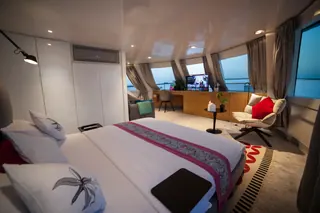
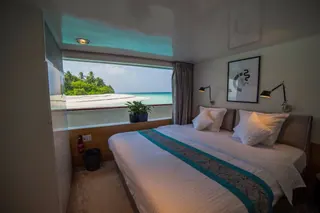
Azalea is a 41-metre luxury yacht designed for intimate voyages, offering space, elegance and comfort in every detail.

41mLength
9Cabins
18Guests
10Crew
Explore Azalea

Best time to go

When to visit the Maldives

Dec – Apr

Dry Season

The Northeast Monsoon brings calmer seas, lower rainfall and the clearest underwater visibility of the year.

May – Nov

Green Season

The Southwest Monsoon brings short showers, lush island greenery, fewer crowds and better value for longer charters.

Mid-Dec – Feb

Peak Season

Festive-period and February travel bring the highest demand for cabins, so these dates are the first to book out each year.

May – Nov

Manta Season

Plankton blooms draw manta rays and whale sharks to Baa and Ari Atoll, making this the strongest window for marine-life encounters.

Behind the lens

Moments from the ocean

Planning tips

Plan Your Perfect Voyage

A little planning goes a long way in ensuring an extraordinary experience. Here are our top tips for your charter.

Read our tips

Pick a route around what matters most to your group — diving, sandbanks, family comfort or a quiet private escape — and let the crew shape the days around it.

From manta encounters to sunset sandbank dinners, tell the team what you're hoping to see and do so it can be built into the route.

Light, breathable layers, reef-safe sunscreen and swimwear cover most days — the crew can advise on anything specific to your route.

Transfers, permits, dining preferences and daily timing are handled onboard, so the only decision left is what to do next.

Common questions

Planning details

Weekly rates in 2026 range from approximately $5,600 for a smaller crewed vessel to $105,000+ for a superyacht. Mid-size crewed yachts typically run $10,500 to $35,000 per week before extras. Budget an additional 20 to 40 percent above the base rate for fuel, provisioning, permits, GST, and crew gratuity to get a realistic all-in figure.

Self-skippered bareboat charters are not a practical option in the Maldives. Foreign vessels operating with tourists aboard require a Ministry of Tourism cruising permit and a separate charter licence. In practice, all Maldives yacht rental arrangements include at minimum a licensed skipper, and most include a full crew.

An Advance Provisioning Allowance (APA) is an upfront fund, typically 20 to 40 percent of the base rate, that the captain draws on for fuel, food, dockage, and port fees during the trip. Unused funds are refunded. It is not a fee; it is a prepaid spending account. Always ask for an APA estimate specific to your route before signing.

Dry season, November through April, offers the most reliable conditions but commands peak prices, with top vessels booking out 6 to 12 months in advance. The shoulder months of November and April offer a strong balance of good weather, competitive rates, and better availability. Wet season, May through October, delivers lower prices and exceptional wildlife encounters, particularly manta rays and whale sharks.

Private proposal

Plan a private Maldives yacht rental

If what you want is the private, fully crewed, single-group version of a Maldives yacht rental, with no strangers onboard, a dedicated dive support vessel, access to remote atolls, and a crew whose only job is your group, that is exactly what Azalea Cruise is built to deliver. Reach out to start planning your charter, and we will build the itinerary around your group from there.

Ready to start planning your Maldives charter?