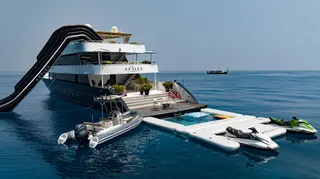
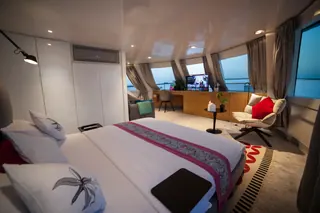
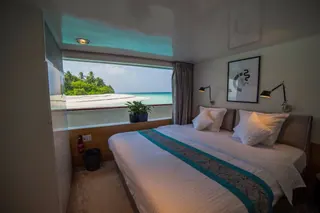
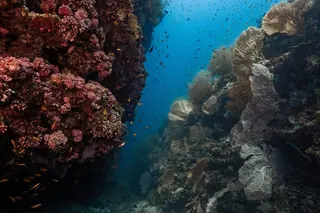
Boat approaching Hanifaru Bay in Baa Atoll, Maldives
Articles

6 min read

Hanifaru Bay Manta Ray Boat Trip: What to Expect

Hanifaru Bay holds the largest documented manta ray aggregation on earth. Getting the most from a visit depends on permits, timing and how long your boat can stay in the atoll.

Hanifaru Bay is a small, shallow bay on the eastern rim of Baa Atoll. During plankton blooms, it concentrates oceanic and reef manta rays in numbers that have no parallel anywhere else on earth. August and September regularly produce simultaneous feeding events involving over a hundred individuals. Getting access requires a permit, a managed entry process and the right boat positioning. This guide explains all three.

How the aggregation works

Hanifaru Bay functions as a plankton trap. The bay's shallow floor and surrounding reef structure cause incoming tidal currents to concentrate surface zooplankton into a dense feeding zone. Manta rays — both the oceanic species (Mobula birostris) and the reef species (Mobula alfredi) — follow the plankton, entering the bay in coordinated barrel-roll feeding formations that allow them to cycle through the densest patches.

The aggregation is entirely tide and plankton dependent. A strong bloom on an incoming tide can bring over 200 mantas into a space of a few hundred metres. A low-plankton day at the same tide may produce fewer than a dozen. This variability is why time spent in the atoll — rather than a single day-trip window — is the strongest predictor of a peak encounter.

The permit system and how it works

Entry to Hanifaru Bay is restricted under a permit system managed through the Baa Atoll biosphere reserve. All visiting vessels must hold a permit, and entry is managed at the bay entrance by a ranger station. The permit limits the number of boats in the bay at any one time and requires snorkelling only — no scuba diving is permitted inside the bay boundaries.

Permits are coordinated through the Baa Atoll Resort. For charter yachts, the permit is arranged in advance as part of charter planning. Entry is allowed at specific windows determined by the ranger, and the session ends when the ranger signals the bay is closed — typically after 60 to 90 minutes.

  • No scuba diving inside Hanifaru Bay — snorkelling only.
  • Entry windows are managed by a resident ranger.
  • Permits are arranged in advance through the Baa Atoll Resort.
  • No touching, feeding or chasing of mantas is permitted.
  • The fee supports the biosphere conservation programme.

Best months to visit

The primary manta season at Hanifaru runs from June to November, driven by the southwest monsoon plankton blooms. August and September are the peak months when simultaneous feeding events are most frequent and manta numbers are highest.

December to May sees mantas in the atoll but Hanifaru is less active. This is still a productive period for manta encounters at cleaning stations and outer reef sites within Baa Atoll — the bay simply does not aggregate as intensely outside the monsoon season.

  • June to November: primary season — aggregations active.
  • August to September: peak — simultaneous barrel-roll feeding most common.
  • December to May: calmer water, fewer mantas in the bay, but still present at outer sites.

What to bring and how to prepare

Hanifaru Bay requires confident snorkelling. The current inside the bay can be strong, and guests need to maintain position without anchoring to the reef or standing on coral. Fins are essential. A wetsuit or rash guard protects from the sun and from jellyfish, which occasionally accompany the plankton blooms.

Underwater camera setups benefit from wide-angle lenses given the density of mantas and the close approaches that are possible when you are in the water calmly. Flash photography can startle the animals — natural light shooting is preferable.

  • Fins and a wetsuit or rash guard are required.
  • Wide-angle camera lens recommended.
  • Avoid flash — natural light photography only.
  • Strong swimmers only — tidal current can be fast.
  • Follow ranger instructions at all times during entry.

Day trip versus yacht: the difference in manta time

Resort day trips to Hanifaru typically allow one entry window per day, subject to permit availability and sea conditions from the resort location. A private yacht based in Baa Atoll for multiple nights can attempt multiple sessions across several days, dramatically improving the probability of hitting a peak aggregation.

The other difference is positioning. A yacht anchored inside the biosphere has the captain monitoring conditions continuously — if the afternoon tide looks better than the morning, the plan changes. A day trip from a distant resort cannot respond to conditions the same morning.

Common questions

Planning details

No. Scuba diving is prohibited inside Hanifaru Bay. Snorkelling only is permitted, which preserves the bay floor and reduces disturbance to the mantas.

Manta aggregations at Hanifaru depend on plankton blooms and tide conditions. August and September have the highest encounter probability, but no wildlife encounter is guaranteed.

Permit availability varies, but a yacht holding in Baa Atoll over multiple days can typically access two to four permitted sessions across the charter. The ranger manages entry numbers, so advance coordination is essential.

Children who are confident swimmers and snorkellers can participate. The current inside the bay can be strong, so younger children should be accompanied by an adult at all times.

Private proposal

Access Hanifaru Bay from a private yacht in Baa Atoll

Azalea can position in Baa Atoll for the manta season with advance permit coordination. Share your dates and the team will confirm availability.

Ready to start planning your Maldives charter?